Sunday, April 28, 2013

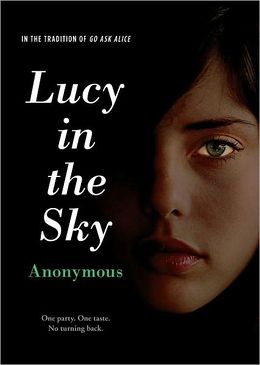
Lucy in the Sky by Anonymous


I originally chose this book because I am a big Beatles fan. This book has nothing to do with The Beatles. 

This book is presented as the diary of a 16 year old girl. She receives a journal on her 16th birthday and decides to start writing in it in accordance with her yoga classes in order to express her emotions and let them out in a healthy way. During one of her yoga classes, she meets Ross, an attractive California surfer who introduces her to a world of drugs and partying. Anonymous, being an awkward teenage girl with few friends, follows him into a downward spiral of sex, drugs, and partying that slowly grows from one drink, one puff from a joint into LSD, heroin, and cocaine. Her brother, Cam, is the only one outside of her group of friends that knows what is going on. Can he or anyone else save her?

This book was met with primarily positive reviews. However, I personally don't agree with these reviews on the basis that this book is presented as non-fiction but is, in fact, fiction. There is a small disclaimer in the front of the book saying that this book is a piece of fiction, but if you're anything like me, you skip all those intro pages and dive straight into the book. It made me think of A Million Little Pieces and the conspiracy that surrounded that. 

I know many people who have experienced hard drug addiction. Their stories are both more interesting and more realistic. For example, Scar Tissue by Anthony Kiedis of The Red Hot Chili Peppers is an extremely moving story about his own experiences with heroin addiction. This story is also true. 

Many of the experiences Anonymous talks about when she's feeling high sound very textbook, and it makes the reader frustrated that she goes back to drugs again and again despite placing more emphasis on the negative things that happened while she was on drugs rather than the feeling of the high. Drug addiction is frustrating. It is extremely frustrating to watch someone go back again and again to drugs despite bad things, but this story is told from the first person. In order to make the ending more shocking and scare kids off drugs (which is clearly the goal of this book), I believe it is important to make the drugs attractive because they are inherently attractive. Kids are smart. They should know that being high feels great, but its not worth your life or your freedom. I find this to be the greatest fault of the book. They need their curiosity satisfied rather than just scaring them into trying it for themselves.

On the other hand, I would actually recommend this book for study in a psychology class. I think that the reactions to having to go through the 12 Step Program and to peer pressure are realistic. I think that when teaching this book, the teacher should spend quite a bit of time on real stories about drug addiction. It is an interesting, though predictable, story, but it is morally questionable. 

Angel and Faith Daddy Issues by Christos Gage

 
Vampires are running the streets of London!  Angel and Faith are needed to save the city.  Drusilla, a vampire with psychic powers, has returned to London.  Angel is left to take on Drusilla herself, while Faith faces her father. 
 
 
Angel had killed all of Drusilla's family.  This is why she had such hard feelings for him.  Instead of turning on him and feeding on him for what he had done to her, Drusilla turned to God.  She was able to put all of her pain and misery behind her.  Now back in London, Drusilla wanted to help all of the other vampires who felt the need for revenge.  She thought that if she could turn to the light side and get rid of her bad feelings, they could too.
 
 
Faith ran into her father, who she did not have a good relationship with.  He told her that he was sober now and wanted to mend their relationship, but Faith did not want to.  Due to their not-so-good relationship, Faith's father knew nothing about what she did.  He didn't know that she faught off vampires.  When he was at her house, he saw the weapons she had and caught on pretty quickly.  It made him feel proud of what his daughter was doing.  


I would reccomend this book to youth who is interested in comics and vampires.  Some of the pictures are a little gory.  Personally, I did not enjoy this book.  I'm not into the whole vampire scene and the gore was a little much for me.  I would suggest no younger than high school just because of the violence in it.  I struggeled to read this because it was in comic form.  It made it difficult for me to follow and get into.  I also had a hard time following it because I have never seen any of these televisoin episodes or comics before.  I came to find out that this book was part of the Buffy the Vampire Slayer series.  This made it difficult to follow when I came into the book not knowing any prior information.

Susceptible by Geneviève Castrée

Susceptible by Geneviève Castrée 


                "Susceptible" is a graphic-novel written by multi-talented artist Geneviève Castrée. The book is an autobiographical graphic novel which Castree is depicted in through the main character named Goglu. "Susceptible" is based on Castrée's own experiences growing up in Quebec with a single mother whose drinking and drug use took a negative toll on her life and forced her to grow up fast. Goglu lives with her young mother and stepfather while her father lives 5,000 miles away. 

                Castrée recounts her life through simple, yet beautiful illustrations drawn by the self-taught author, who never officially studied art. The book goes in chronological order all the way until Goglu is an 18-year-old woman and is free to leave her house and do what she wants. Although Susceptible is frequently described as an autobiographical graphic novel Castrée admits that the more people read this book the more she feels wary of calling it an "autobiography." In an interview with Comic book Resources Castrée says "I tried as hard as I could to stick to the truth, but it seems that as soon as the ink hits the page, the story is compromised, and then as soon as it is read by another person, it is distorted. A book can be read a million different ways by a million different people, so I am glad I changed the names of the people involved."

                 My favorite part of the book was the beautiful illustrations. You really see the emotion and feelings behind the expression that the characters make. Goglu's mother especially was illustrated very well. The bags under her eyes, unkempt appearance and bad posture brings the young mother with substance abuse problems to life. One thing that I didn't like about the book was the tiny handwritten cursive that it was written in, I felt that it was really hard to read at times and sometimes not even legible to me.

                Geneviève Castrée's talent doesn't stop at just writing and illustrations, the young artist also is working on her own solo music project were she goes by the name "Ô Paon".  Below is a performance by Castrée at a festival that she organizes with her husband called "What the Heck"

Can I See Your I.D? by Chris Barton


When I saw the title of the book I thought about people stealing Identities for bad purposes but to my surprise the book is relevant and engaging. Identity theft is a growing threat, especially to the young individuals. 
The book is about 10 stories of individuals many just teenagers who adopted false identities for enjoyment, profit, or survival. From Sarah Rosetta Wakeman, who disguised herself as a man to fight in the Civil War, to 16-year-old Keron Thomas, who in 1993 impersonated a transit worker to fulfill his dream of piloting a New York City subway train, but the most powerful stories, assuming a false identity was a life or death decision, as with Soloman Perel, a Jewish teenager who joined the Hitler Youth to escape being killed, and Ellen Craft, a slave who disguised herself as a white Southern gentleman to escape to the North.
The book reveals the motivations behind dishonesty also at the end of each story the Author gives us a, What happened Next? section, in which he tell us what happened after the event. The book material  is carefully researched, bringing together all the stories and is wonderfully written. "Can I See Your ID" will motivate many young readers to enjoying non-fiction. 
I will definitely recommend  this book because with the use of narration it creates a very effective way of making the reader imagine the identities of each individual.  At the end of the book the author gives us some insight on how researched and wrote this fascinating and clever book.


Elephant Talk The Surprising Science of Elephant Communication by Ann Downer


Have you ever wondered what animals are talking about when they talk with each other?  Or maybe what it means when they make certain noises or actions?  This book is all about elephants.  Body language and different sounds all make up elephant talk.  These creatures have been part of our lives for thousands of years.  Unfortunately, elephants are endangered due to poaching.  Getting to know more about these animals and how amazing they are might help them from going extinct.

When an elephant is just a baby, the begin to pick up on the different cues and calls of their language.  The go through similar stages as humans.  They have a toddler stage, a teenager stage, and an adult stage.  When the elephant starts to show signs of being sexual, the mother will back away and the elephant will usually join a group of other single elephants.  Their life span can be up to sixty-five years old.  Elephants live in groups.  These groups are composed of family members of different generation.  This too is similar to humans.  Elephants work together in their group.  They defend and care for one another.  Each group is like a large family.

 
Elephants use a variety of different sounds and tones to communicate.  We've all heard the typical elephant call at the zoo.  This is what we tend to associate elephants with, but they have many more forms of communicating.  Some of their calls are much too low for human ears to hear.  They actually have a ten octave voice scale.  There are ten distinct calls elephants make.  Some are made with their throat and others are made with their trunk.  The ones made in their throat are the bark, the cry, the grunt, the husky cry, the rev, the roar, and the rumble.  The ones made in their trunks are the trumpet, the nasal-trumpet, and the snort. 


Aside from physical sounds, elephants also have different gestures and cues.  The use their ears, trunks, tails, and smells to play, impress mates, and send warning signs to other elephants.  When elephants are looking to mate, the female does a walk where she circles around and looks over her shoulder.  Males will wave their ears and trunks and urinate.  Elephants shake hands by intertwining their trunks with one another and inserting the tip of their trunk into the mouth of the other elephant.  When elephants flap their ears an one another, it is a sign that the group is getting ready to move to another place.  When the elephant runs with their tail straight out, it means there are lions in the area.  There are tons of different ways elephants communicate with one another.


Overall, I thought this was an intersting book.  It's cool to find out that animals have their own forms of communication just as we do.  I also really enjoyed the website http://www.elephantvoices.org/.  It made me appreciate the beauty of these animals even more.  

The Holocaust has been a part of education curriculum for years. We have learned about the larger than life villain, Hitler, that started the mass slaughtering of Jewish people, we have learned Anne Frank’s story, and we have heard of the concentration camps that so many have died in. We have heard from a few people who have lived in during the Holocaust, but it’s hard to make each individual story sum up the mass amount of people affected and hurt during this time. Ruth Thomson gathered facts, stories, maps, artwork, and true accounts of survivors in her book Terezin: Voices From The Holocaust to accurately tell the stories of the Holocaust.

We all know about the Holocaust, but Thomson’s book Terezin: Voices From The Holocaust offered clarity with facts and stories to make complete the true accounts from every angle. For starters, Thomson doesn’t only talk about life hiding from the Nazi’s, or what kind of madness swept over the nation with Hitler as their leader. Thomson tells the story of the victims, and starts from the beginning.

Thomson writes about life in the Terezin ghetto where Jewish families lived in horrific poverty. The ghetto’s name was eventually changed to Theresienstadt by the Nazi’s and was turned into a concentration camp. Theresienstadt served as a “transport” camp that hosted thousands of inmates. The Nazi’s used this camp as propaganda and acted like life for the detained was not bad at all. The camp was supposed to stand as a disguise or mask for the gruesome death camps, and it tricked the people of Germany. The inmates had to tell their stories by keeping secret journals, artwork, and letters, and Thomson displays the hardships they faced as she unveils their work.

Thomson’s book is well researched, educational, and a truly griping read. She supplies readers with statistics. For instance, there were 86,934 who were transported from Theresienstadt, but less than 3,000 inmates survived. The number is astounding. Thomson does not just supply readers with facts, she tells stories of survivors. The survivors explain what life was like when they describe life living among the dead corpses. They describe the hardships of mourning when they would pass around the ashes of their dead friends and family.

Thomson’s book reads like a text book with headings, factual information, and some pictures. However, her use of survivors’ stories was the most interesting, yet devastating part of the book. Having learned about the Holocaust while I was in school, and then assisting in teaching a Unit on the Holocaust, this was my favorite book I have read about the Holocaust as well as the most useful.

Prior to reading this novel, I did not know that the Nazi’s even tried to mask any of the conditions of the death camps from the people in Germany. The Teresientstadt ghetto was supposed to deflect attention from the real crimes being committed. Thomson digs for the truth and quotes survivors in mini passages to explain what life was like there on a daily basis by explaining the jobs, the food, the death, and the setting in their own words.

I would include this novel in my classroom if I was teaching about the Holocaust. I would read it along with Anne Frank’s Diary. The content and gruesomeness of the Holocaust is very evident in the text, which might be too much for younger teens. I would teach this book in an eighth grade or high school setting.  I also found a video on YouTube that exposes some of the truths about the Teresientsadt ghetto that Thomson talks about in her book. The clip is long, but I think it goes hand in hand with Thomson's book. The video pasted below is different; its a shorter clip of what Terezin looked like then and today.
 
Thomson's book recieved rave reviews. She even won an award for her writing; she won the 2012 ALCS Educational Writers' Award. Here's the link to the website that talks about her winning the award for her book  Terezin: Voices From The Holocaust. Her book states that it is intended for audiences 11 years old or older.
 
Here's a link for additional information about Terezin that includes some pictures. For those who are interested in reading this book, the information here can be helpful for you.
 
This book is not just a great read for a classroom setting. It's fascinating, and it is an enjoyable read. It's a shocking book that helps you better understand the Holocaust, and after you read it, you truly feel impacted.

Tilt by Ellen Hopkins

Being a teenager can be the hardest years of someone's life. You have to learn so much along the way: friendships, family dynamics, what being an adult means, what growing up truly means, what is right or wrong for you like drugs and alcohol. Ellen Hopkins has crafted an amazing novel with these themes in mind, along with many others I do not want to spoil.

The stories told in this book are excellently crafted:

Mikayla is seventeen and is starting off her summer right by going partying and spending time with her beloved boyfriend Dylan, who she knows she is in love with. The parties continue and Mikayla is falling further in love with Dylan, but love sometimes comes with a price, right? Also, Mikayla is noticing that something is going on with her mom and dad, but is too involved in her own life, for the moment. What will come of them?

Shane is a young, gay guy who has been so entranced with finding the right guy for him, He has been looking around online and thinks he has found the guy for him, perfect for his summer vacation. But his home life isn't really looking up. His young sister, Shelby, is sick with Type 1 SMA, and which has utterly consumed his mother's life. His father on the other hand, works extremely long hours and when he is home, drinks... a lot. So the focus is on Shelby, which Shane is okay with, most of the time.

Harley is a young, growing girl. Her parents are divorced and her father doesn't really talk to her much. But for some odd reason, her father has taken an interest in wanting to get to know her more this summer. Harley is both excited and a little mad. Why now she thinks? Well, the answer may lie in her father's new girlfriend. Harley comes to look up to her after a bit and especially admires the girlfriend's son, Chad. Harley decided it's time to grow up, and she hopes it happens quickly.

All these stories intertwine, but all the stories combined, their lives will hit a-
Tilt has been such an amazing novel to read. It is an emotional roller coaster ride that would both hit home with parents, teacher, and student alike. And to give even further context, Ellen Hopkins has an adult novel, called Triangles that might be more insight, at least for parents. The novel has so much potential to be taught in a classroom, even though it is a bit risque; there is a lot along the lines of drugs, sex, and explicit themes ta, but things that teenagers are doing anyway. The book, in no way, glorifies these ideas, and actually shows the repercussions of doing them which is one way it would be great to teach in class.

The book has potential in a classroom other than the mentioned lesson above. It would help students learn how to make a character web or list, since that is about the only confusing part of the intertwining story lines. The book is written in a poetry format, free-verse (here is an example and a great excerpt on Ellen's site of Tilt), which makes for a quick read, even though it is a little over 600 pages. It could also be great to assign as extra credit in a Health Education class, and it could also generate some great questions that teens might have about sex and drugs.


100 Deadliest Things On the Planet, by Anna Claybourne

    We are all born, we all live, and then we all die. This is the human condition, and at times it seems exact and predictable. What is interesting though, is that we do not all die in the same way. Though it may be comforting to picture death from old age in the comfort of your own home, there are plenty of more interesting and less desirable ways to go.
   
    In Anna Claybourne's alarming yet educational book, 100 Deadliest Things on the Planet, many of the world's most frightening plants and animals are accounted for, and in detail their deadly attributes are examined. What this thin book lacks in length, it makes up for in forthright and striking factual detail. Claybourne covers a wide range of the world's death traps, from False Morel, to the more understandably frightening Funnel-Web Spider, and the obvious killer, the tiger.
   
    The Australian Brown Snake is a decently common snake that lives near many residential ares in Australia, the unfortunate reality of this is that the snake is easily agitated and is not shy about delivering its incredibly life threatening bite. Foxglove is a beautiful species of flower that is also a powerful killer. It is known by its "dead man's bells" which are long strings of bell shaped flowers that are poisonous to the touch. Stonefish are known to hide at the bottom of deadly pools of water and sting people who may accidentally step on them. Their spines are filled with the deadliest venom of any fish, and can leave the victim paralyzed and can also cause respiratory failure. These are just a few examples of the deadly and fascinating creatures discussed in the book.
Pufferfish, incredibly toxic. 
   
    This small but fact filled book would be interesting to almost any student capable of understanding the text. Any science class would no doubt benefit from assigning a book such as this, it encourages reading while at the same time providing students with a plethora of scientific facts about a variety of plants, animals, and bacteria. I would say that any student from 6th grade and up would enjoy this quick but exciting read. This book fits better into science classes, but could also definitely count toward some required reading in an English class as well.